James was born 24th December 1858 at Heatherinch in Collessie, Fife ... to Jessie/Janet Crombie …my great grandmothers’ older sister …well one of them …there were seven daughters of whom Isabella was the youngest… and one son …the oldest of the siblings.
Tuesday, 24 January 2012
James Stark ….from humble beginnings
James was born 24th December 1858 at Heatherinch in Collessie, Fife ... to Jessie/Janet Crombie …my great grandmothers’ older sister …well one of them …there were seven daughters of whom Isabella was the youngest… and one son …the oldest of the siblings.
Saturday, 1 October 2011
Alexander Ritchie …1868-1914.
Sadly I have no stories or anecdotes, past down through my Nana, about her brother, my Great Uncle Alexander, except that he was ‘fond of his appearance’ which I assume meant he liked to look smart … and that he was called Sandy by the family. I believe he had light read hair, which may have given rise to the nickname.
By the time my Nana was nine (1891) it can be seen that Alexander was no longer living in the family home but was a lodger in Carnock .. a village a few miles west of Dunfermline….how long he had lived away from home is unknown.
I have tried to gather as much colour from certificates and censuses I have read…. hopefully giving him a ‘real’ feel …some one who is not just a face staring back from a photograph.
Alexander Ritchie was born 12th September1868, the third child but second son of David and Isabella. He was named after his mother’s father, as tradition dictated, and was brought up in Cupar Muir, in Fife … which is just outside Cupar. I have noted that none of the sons were given middle names at birth although William adopted one in later life, yet all three of the daughters were.
Like his elder brother he followed his fathers trade, that of being a Stonemason, and after finishing his apprenticeship, of about 7 years, he was then a journeyman …acquiring work where he could and often paid by the day. The only thing he was not allowed to do was to teach …for that you had to be a Master Mason
By 1897 he was living in Edinburgh, at 36 Caledonian Crescent, and on the 23rd December that year, he married Barbara Low Anderson who lived in Glasgow and was a sales lady in a jewellers. Alexander was now termed a Mason, (Operative) as also was his father who still lived in Cupar Muir. I have read up on this but there does not seem to be a definitive answer as to what ‘operative’ actually meant. In some cases it seems that it was connected to being a member of a Lodge of Masons but then I read it was something to do with the early unions …even ‘journeyman’ seems to have many definitions…does any one out there know more ???
!901 brought the next census and the couple are found to be one of three families, living at 12 Castle Street. Edinburgh. … Alexander is a working Mason and Barbara is a caretaker of an office …they have no children.
Another 10 years pass and they are now living at Quarry Brae in Polmont, in a house or cottage, called ‘Kenmore’, that has 6 rooms with windows. This seems quite large for a couple still with no children after 13 years of marriage but reading the census I see that he works on his ‘own account’ now, from home and he is now a Fruiterer. This says to me that this building is in fact a shop, a Greengrocers maybe or a general store.. There is no record of Barbara’s job but I imagine she served in the shop or helped in other ways. They appear never to have been blessed with children but I did wonder why he rejected his trade to start a new one during the first decade of the 20th century.
All was explained when reading of his death on 18th October 1914, just three years later, at the age of only 46. He died of pneumoconiosis and heart disease ….the former being a ‘Dust disease’ related to being a stonemason. I can only imagine that he had been ill for several years and this had caused him to change his direction.
I hope Sandy came alive for you …he did for me while researching him …but then he is my Great Uncle.
Now I know where he lived in his latter years, I am going to send my son out with a camera, as he lives surprisingly close to Quarry Brae.
Tuesday, 19 April 2011
The Ritchie Family circa 1875
Tuesday, 1 March 2011
My Mum ...in the 1940's
This decade was filled with mixed emotions for Mum It started with such promise …she was due to be married to her one true love but sadly John was taken from her before it could happen … she managed to survive this terrible time and took her mind off what had happened by concentrating on her singing and joining the world of work for the first time in her life …something that a middle class only daughter, in Scotland, was not expected to do unless it was volunteering to do a few hours for charity or in a hospital, or at this time, maybe War Work.
She lost close friends as many did …sang for the Polish soldiers who were stationed near by …finally left home for a spell so she could continue working and have some independence …this time on a military base in England … then discovered that her mother had sold up the family home and followed her to England. She met and was captivated by my father, a Canadian parachutist at the base … learnt that he was returning home to a wife and child so never told him that she was probably pregnant. In March 1947, she gave birth to me, which shocked the whole family, as she had told no one, only put on a few pounds and cycled everywhere up to eight months. Finally she let her mum find a flat, change Mum's surname, move in with us and then organize her life so that she could keep me and give me a home, forsaking old friends, in case they ever learnt the truth that she had never married. …. but then, to test her strength once more, she nearly lost me to Polio as the decade was nearing its end. (Written about in the post below )
This beautiful woman never looked at another man for the rest of her life and dedicated herself to making sure I was happy and had all that I needed. …it is now that I really appreciate what she did for me.
Thank you Mum.
ME
The first photo must have been when I was nearly one, early 1948, and the other, two years later. For the first three years of my life I lived with Mum and Nana, in the down stairs flat of a house that had seen better days, This was before my Nana purchased a Victorian terraced property, opposite a park, which was to be my home for the following 18 years.
I remember discovering a hole in the kitchen floor and peering in … and then a wooden chair being placed over it to stop me coming to harm. I remember Mum looking after the Lipmann’s cat and she and I having to go up to their flat, only to discover a pile, or as it seemed to me, a mountain, of stale and mouldy bread in a corner of their hall. I remember lowered voices when it was ever discussed..
It is only with retrospect, and age, that I now suspect why the ‘mountain’ existed. The Lipmann’s were always nice to Mum and talked to me too but generally kept themselves to themselves. It was the late 1940’s, their surname suggested that they were Jewish but although their clothes were showing much wear and tear, they seemed have a pride in their appearance. Putting all things together in my mind, I now wonder whether they had managed to survive a camp or similar hardship, where any food was rare and prized, no matter the freshness. The habit to treasure any crumb of food would have been hard to break and to throw anything away would have been almost impossible. … it really is the only explanation, as I remember Nana remarking on how clean and tidy the rest of their home was..
These things I remember, even though I was so young yet a two months stay in hospital, around the age of 18 months, separated from my mother by a glass wall, leaves me with no memories at all.
Between these two photos I fell ill … according to the doctor …with a cold or influenza at worst. My ex-Theatre Sister Nana was not satisfied and had me rushed to the nearest hospital …she was a force to be reckoned with when it came to medical matters and her intuition was right. Within a few hours I was diagnosed with Polio and put into isolation. It is believed that it was only her quick action that enabled me to make a complete recovery …well almost, as I walked like a penguin for the next three years and my feet would often take up the ‘quarter to three’ position when tired …even well into my twenties. Certainly there would never have been such a cute photo of me at nearly three but for her…many children who managed to survive the terrible epidemics around that time, remained paralyzed and those that were confined to a chair or walked with the aid of ‘leg irons’ were thought lucky.
Thanks for dropping by ...Take Care xx
Tuesday, 30 November 2010
Never to be forgotten
He had volunteered for the Air force as soon as war broke out, much to mums annoyance and after training, was given the dangerous position of rear gunner. He was soon told of his promotion to sergeant and that he was to become an instructor, reducing the chances of flying missions. This being the case both John and Mum felt more confident of their future and they dared to think of marriage plans, maybe on his next leave.
At the end of June 1940 Mum was informed that he was missing in action …. from the 17th …she was devastated but did not give up hope over the months that followed, often walking where they walked together and praying for his safe return, imagining him being a prisoner of war.
At the end of December the grave news came that he had been killed on the 17th June and buried on the 24th, at St Nazaire. Mum told me that he had been thought to have been on the troop ship ‘Lancastria’, when it was bombed and sunk, so had actually survived some conflict in the air before hand.
This was all that she knew … and I certainly had never heard of the ship and its sinking … so when I was reading and transcribing mums notes and memories, that I had persuaded her to commit to paper a few years before her death, I did some research.
He was on the list of those lost on the ship and probably was below deck in line for a direct hit. It is a tragedy that was hidden from the British public, for fear it would damage moral at a difficult time ….a Churchill cover-up. There is a book well worth reading….The Sinking of the Lancastria by Jonathan Fenby ….. if you are interested …. but facts that should be known are that if you add the number of dead from the Lusitania and those from the Titanic, together, you still have not reached the suspected total of lives lost from the sinking of Lancastria and this occurred only two weeks after the well documented, Operation Dynamo…..which every one knows as the evacuation of the troops from Normandy beaches.
John may not hold any ties to me but I do not want him or the Lancastria, forgotten …. so this LO will proudly sit within my FH album as a reminder for any that look through, in the years to come..
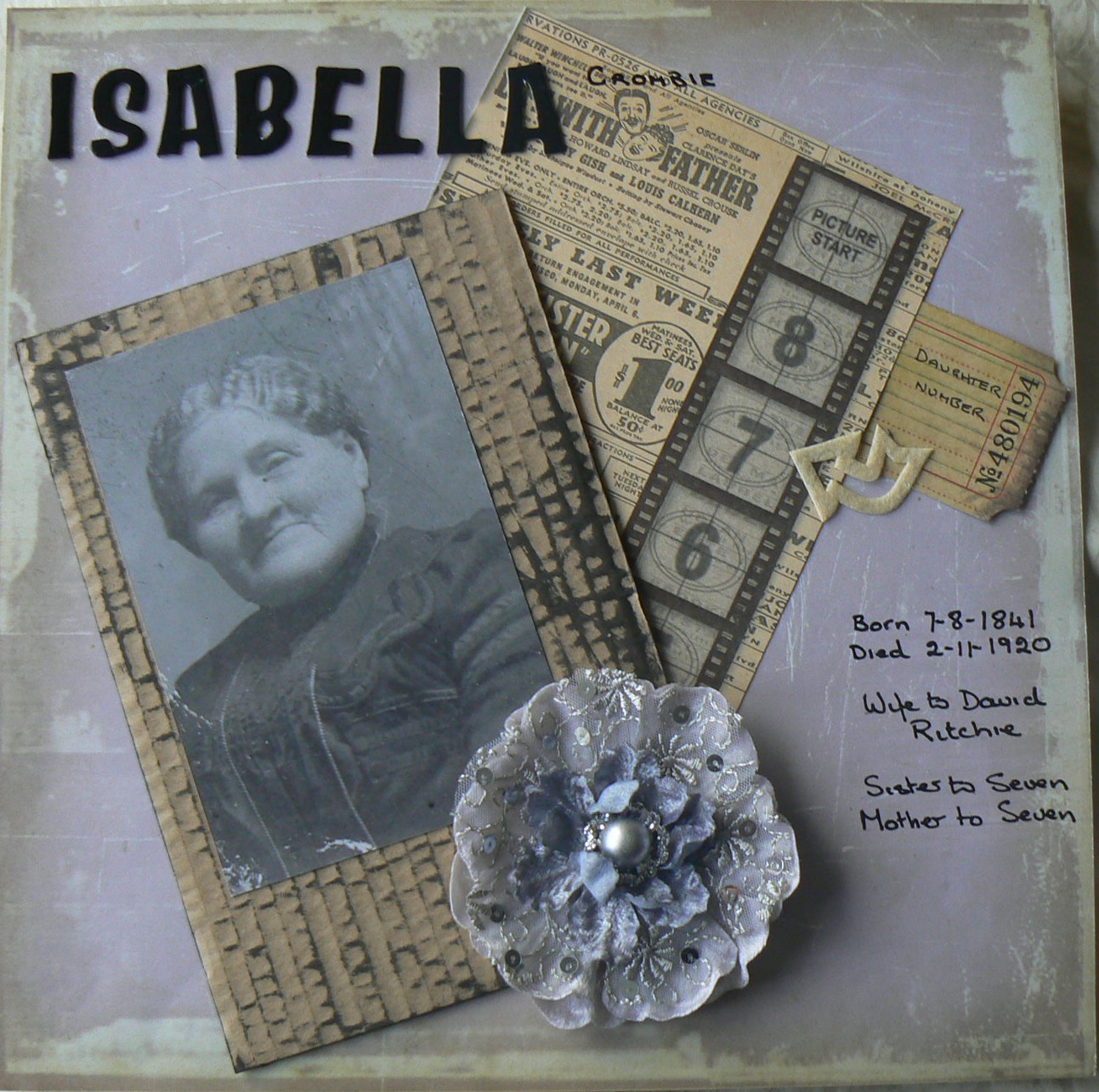
My Great Grandmother Isabella Ritchie nee Crombie
Monday, 19 April 2010
Edith Frances .... my Great Aunt
Edith was the third of George and Emma Bullock's children. Sadly her first two siblings had died before she was born. Ada Sophronia was just one and Ralph Yelland, barely two. A year after his death, Edith arrived ...how her parents must have worried...would she too be taken from them? She survived and was joined by a little brother, Horace Yelland, seven years later. (My Grandfather). It was told to me that George had been a church organist but I have no evidence of this. Both of the children were encouraged to play an instrument, Edith ... Piano and Horace ... Cello and as a result of George's encouragement and their hard work, they became accomplished musicians.
I feel that Edith was special to her father and so when she started to ' walk out' with Herbert Mobsby he was not a happy man. He did not approve of her choice of future husband and tried to discourage the match ...wanting her to pursue her music. Edith, however, chose Herbert which ...it is said ... resulted in her father refusing to attend their wedding in 1900. She was 33 so he could not forbid it but it has been said that he totally cut her off. This might be the case but in George's will he did in fact leave her several properties that he owned but worded it in such a way, that Herbert himself could never gain from any inheritance Edith would receive. They had a daughter Irene and a son Eric but the two halves of the family never had much to do with each other and after Horace moved to Scotland, in 1916, I do not think he ever saw his sister or any part of her family again.
This year ...nearly 100 years on ....I have made contact with Irene's son. We found that through out most of our lives we managed to live only a stones throw away from each other but knew nothing of each others existance. Now we have exchanged some family history and tied up loose ends....small world.
Monday, 1 March 2010
Dr Reginald Yelland Bullock 1914-1963
It’s strange what you learn about people after they are gone. His son, who I recently met for the first time in over 30 years, always thought his father had been born in Scotland ... when he actually had been born in London. During the ‘get together’ we reminisced over our youth, he talked about his life in New Zealand and about his father who Mike sadly lost when he was only 17 … and I filled him in on our Family history.
What I didn’t know was that, although he was a wonderful conscientious Doctor …adored by his patients …he never actually wanted to be one. His love was apparently music …cello like his father but his mother (Euphemia) said it was not a proper job …it was for pleasure. I found it strange because her late husband, Horace, had been a cellist and taught at home. Horace did have an inherited private income, which I suppose made a difference but maybe being forced to do something his heart was not in, is why Reg grew away from his mother after the war years …. along with her disapproval of his choice of wife ….well no one was really good enough for any of her children.
He had studied hard at St Andrews and the only exams he failed were his finals, which he had to retake after being banished to a tent in the garden in order to avoid any outside influences, which might distract him. After he passed it was not long before he had to go to war, serving on the Hospital ship ABA and finally his theatre of war was to be North Africa …..his final rank being Captain.
I found letters amongst Mums papers, that had been sent to my Nana and it could be seen that, as the war years progressed, there were more censored black lines than actual text … how I wish they had not become miss placed in the move up here.
He never let on how ill he had been during that time until much later and I remember that after his death in 1963, Auntie Pat found papers showing that he had been ‘mentioned in dispatches’. He was not one to brag … business like, yet caring, in his work … and always seemed to be the life and soul of any party or gathering. His smile was like that of a mischievous lad and his laugh was so infectious … the latter often heightened by ‘a wee dram’..
Sunday, 1 November 2009
Lily McMillian ... nee Ritchie.
Her father followed his father and became an apprentice mason and then a builder and finally a Master builder, living his life in Cupar. He was very fond of his drink and sadly died three years before her marriage ...of alcoholism ... in his late 50's.
Lily loved her Amateur Dramatics as can be seen in the shot with an umbrella and was greatly admired for her beauty, when she was young but it is said she was determined to make a good match. She met and in 1925, married Donald McMillian, who was 10 years her senior but comfortably well off ..... his trade ... a Merchant.
Soon after their marriage they moved to South America and their children Margaret and Donald were born. They returned to Scotland in 1933 from Ecuador. Even in her latter years she remained a striking woman
Thanks for dropping by. xx
David Ritchie 1839-1896
He was born in the tiny village of Blebo Craigs in Kemback, Fife in the year 1839. He was the first born of 8 ...well that's the number I have found so far. During his early years he lived close by to his grandparents, David and Margaret Ritchie in Kemback. His father, also David, was a Journeyman Stone cutter.
In about 1846 his family moved to Brighton, Cupar Muir, just out side Cupar. His mother, Agnes, worked as a Linen Weaver there .... just as she had at Ceres, before she was wed. By 1851, David, at the age of 13 had joined her as a hand loom weaver and his younger brother William worked part time, still keeping up his studies.
By 1861 he had changed trade and was now an apprentice Stone Mason. His father died of consumption in January 1863 and he married Isabella Crombie whose family also lived at Cupar Muir in the December of the same year.
I know little else about him except his attitude to his daughter becoming pregnant.
I find it interesting to look at the attitude to an illegitimate birth back then and how two similar men dealt with it.
Isabella's sister gave birth to a son out of wedlock but the father gave the boy his name, although there was little contact after and her father accepted him as his grandson and helped to bring him up. If I can find a photo ofJames Stark, there is a wonderful story of his later life.
David was very different when his eldest daughter became 'with child'. It is thought that the son of the Farm manager where she worked, was the father, as the surname was used as a middle name .... sadly no fathers name was recorded so he could not bear his father surname.
It also seemed strange that she gave birth at the farm and not with her family who lived close by but it is said that David was very angry and had as good as thrown her out.
David Lowson Ritchie was born in 1886 but by 1891 he was found as a Lodger with the Berwick Family in Kettle. It is said that her siblings and probably her mother tried to help her at the time of the birth but it was just too hard to keep him. Apparently it was quite normal for a baby to be 'lodged' if a mother could not care for a child, as there was no official adoption, and the church paid for their board.
By the middle of 1892 she was being married to Thomas Moncrief of Edinburgh and her home is recorded as Cupar Muir rather than Edinburgh where she was working in 1891. I assume she was welcomed home with out the child, having spent enough time away, for people to forget.
Her son was still living with Mrs Berwick in 1901, barely 10 miles away, but she now had two of her own from the union with Thomas and by 1905 she and her new family had emigrated to Canada while David lived on believing that his mother was dead and that she had married Mrs Berwicks son, who was also deceased. In his twenties he changed his name to David Ritchie Berwick.
David Ritchie died of a brain tumour in 1896. He may have been hard on his daughter and on his other children but I feel that how his family behaved and appeared to others was important to him and he worked hard to provide for them. My Nana (his youngest child) inherited this 'keeping up appearences' front.
Thanks for reading this xx
Saturday, 3 October 2009
Leith Hospital
This is going to be quite a long post but for those who love a good yarn and some history too I hope you like it --> HISTORY of LEITH HOSPITAL
Sunday, 27 September 2009
Tiny Dancer
These are my Mums words, from notes that she wrote on her young life and it talks about the making of, what I believe, is this dress not long before her father died in 1927.
……. As a child you are not really aware of how well off your family is but I suppose we could be described as being comfortable, yet mother would rarely buy anything that she could get cheaper else where and she revelled in the sales. Maybe mother’s careful management of money was how we afforded to have help in the house. Mary came in everyday until I was about ten.
Some of her sale bargains were lengths of material, which would be put away until there was a use for them, either by her or a dressmaker. Sometimes the fabric was really not suitable for the garment that was required but if that was all that she had at the time, it would be made use of.
Once I needed a special dress for a dancing exhibition so she pulled out yards of a horrid drab material and proudly announced, “That will do nicely”.
My heart sank and I suddenly did not want to be in the exhibition at all. There still was one hope left and that was Father. Mother rarely did anything without checking with Father first and so she went to show him her find.
“What do you think about this for Marjory’s dress?” I heard her ask.
I had followed close behind and arrived in time to see Father shaking his head slowly and giving his reply.
“ What ever you do Jean, do not make a fool of the child.”
Mother had her answer and the next day she came back with some beautiful pale pink satin and some other bits for frills and decorations.
Hope you like my stories
Take Care xx
Family Gathering
Bella, who was actually Agnes Isabella, was the older sister of my Nana, Euphemia Jane aka Jean, by five years. They both lived in Fife, and their families would gather together, often in her garden. Her garden brought her so much pleasure and she even kept a couple of chickens down at the bottom of it. Her husband, James Kidd Brown, was a gardener and worked away from home for a large part of their married life, in some of the large houses …and even in England.
This gathering is in 1925, not long after their niece Lily was married, where both Ella and Marjory were Bridesmaids. (Marjory is wearing her dress as a Best Dress now)
This tag shows who's who
James and Bella had three children Ella, Oswald and Helen.
In 1918, when Helen unexpectedly collapsed in front of her mother while dancing around the kitchen, both the doctor and Euphemia were called for. Immediately Euphemia answered the call for help .... even though she had year old twins at home.
Sadly Helen died less than a week later, of the flu that spread through out the world and claimed so many lives. She was only ten years old.
It was said that Bella never got over her death … I can see the sadness in her eyes.
The other significance to the top photo is that it is the last picture I can find of Horace, my grandfather, who died less than two years later.
Take Care xx
Great Uncle Bill and family
William Crombie Ritchie … the middle name I believe was added in later life
b1873 ….m1902 ….d1951At the outbreak of WW1 he was a Lieutenant in the 18th (Reserve) Battalion Royal Scots. At the age of 40+ and the fact that he was in a reserve battalion, it was thought that he was unlikely to have seen action, possibly behind a desk, but in a piece I found, that he had written about his mother at the time of her death in 1922 … he mentions the war
“….. We were forced to make long night marches, and in our attacks we had to leap wire entanglements and trenches, but never once did any of my young comrades say, or even give it a thought, that I was double their age ….” …obviously he was not behind a desk.
At the time of writing this he was engaged in …. “... squaring accounts and details of the Great War ….” and was now the rank of Captain.
Family was important to him but sadly this line ended with his children.
William and Doris never married but Betty and Sybil did … as can be seen in the LO below.
Sybil apparently had no children and I know there was a story told to me about the reason but I have forgotten …maybe I will remember when I’m not trying.
Betty’s tragic story I do remember .....
She miscarried a child and soon after they found she had a problem with her heart. She however fell pregnant again and everything was going well. She and her husband lived in Glenluce where he was a teacher. It was a very remote area and one doctor covered a large area. This doctor also has his own problems to cope with … the tragic death of his only son … and his patients felt that that his mind was not on them … and it proved to be the case with Betty.
She became very tired and sick but it was put down to her heart …then strange marks appeared on her body, which were ignored. Finally, when she was actually bed ridden, it was taken seriously and it was discovered that the twins she was carrying had been dead for sometime. She was taken to hospital but died of blood poisoning a week later, aged 33
.Take Care xx
Sunday, 16 August 2009
A Veteran of the Civil War
John F Blum is my late husbands’ Great Grandfather. He lost his arm in the Civil war while a teenager, met and married his wife Hulda, in his thirties, and fathered 10 children, of which 7 lived to adulthood. He was born in Pennsylvania, of German parents, brought up his family in Big Stone, Akron, Minnesota, where he farmed for a living and then around 1895/6 he moved to Fitzgerald, Georgia.
Fitzgerald was the dream of P H Fitzgerald, who created it in 1895, in the main part, as a community for Civil War Veterans who had suffered the devastation of the Midwest during the early 1890’s. This destruction of the area was due to drought, rendering a once fertile farming area into dusty wasteland. The situation was made even worse by the depression that spreading over the country as a whole. The desire for a new start was so great, that people moved themselves and their families, by any means available to them, into the area, even before surveys of the land had been carried out. The first year was very hard and it is believed that John and his family were in at the start of it all.
Chalk and Cheese
His word was final yet he let his beloved wife have most of her own way in matters that he felt need not concern him. Although he was the musician, he always asked Ritchie (or Jean as most people now called her), if a piece of music was going well or what he should play at a recital.
Her beloved Horace was sent to church every Sunday, in case any one noticed an absence of the family or that she might miss any goings on! He was always bombarded with questions as he came through the door and Mum remembers him eventually learning to raise his hand as he crossed the threshold, and utter loudly “Jean …..I have been seen”.
I am not sure about the date but looking at their faces and clothes, I believe it to be around 1919.
The Mobsby Family
This was my great Aunt, and her family. My Nana disliked her husband for some reason and mistrusted her son …I can remember mumbled conversations, when I was a small child, filled with warning for my mother about not getting in touch with them and ignoring Eric if he contacted her, Wish I knew the story as I never met any of the family, yet Irene and Eric were alive in my life time.
On the back of the LO I have recorded their little tree for posterity
My Mum ...1934
This is my Mum when she was about 17.
Would you guess that she had an arm that was thin and frail compared to the other and didn’t work properly … or that one leg was 1”shorter, and much weaker, than the other?
No one really knew why. It was thought that it was due to a difficult birth but others said it was a congenital defect. At the age of twelve her mother was offered an operation that might help the mobility of her daughters arm but on hearing that there was a high risk of the arm becoming totally paralyzed, if the operation failed, she refused it.
Mum told me that she was in two shows for her local music society … Rosemarie and Maid of the Mountain … not sure if this is from either but looking at the scenery in the back ground, it just could be, which, after some research, would actually make her 18/19 not 17 as she had always told me.( I have left the LO with the date she said.).
She had a beautiful operatic voice, accompanied herself on piano and also played violin in an orchestra, despite her arm …such a talented lady but so unassuming. Her youth was filled with music …maybe this was how she felt close to her father whom she had adored.